Stewards
Information on Website League Stewardship.
Note: The Accepted Proposals book include various approved details with respect to stewardship procedures, such as adding new stewards and voting on procedures. If it's not here, you may find what you're looking for there: Accepted Proposals
- What is a Steward?
- How to Become a Steward
- Central Services
- How to set up votes on Loomio (Consensus)
- How to talk on Zulip (Coordination)
- How to write documentation in Bookstack (Information)
What is a Steward?
Generally, the League operates as close to a flat structure as it can be. While it's unlikely that every individual who uses a League node will vote or even want to vote, if they choose to participate in the decision-making process, we encourage them to do so and are happy to have them on board.
Stewards
Our decision-making body is made up of stewards, who vote on proposals, maintain our central infrastructure, contribute to our information pages, and work on projects that the league undertakes.
The role of steward is open to every user in the league. Node staff (moderators and operators) are encouraged, but not required, to take on the role, and other individuals are welcome to sign on as stewards, as long as existing stewards can determine that the individual is acting in good faith and no further objections are raised to their stewardship. If an objection is raised, it will be done so transparently if possible, and privately if not, but any objection will be investigated before a decision is made.
The expectation is that if you say you are going to take on a task, that you follow through with it, or ask for assistance if you are unable to do so.
Regardless of whether they choose to be a steward or not, node staff are still required to abide by the Website League's code of conduct, and address issues within their own node, or respond to reports made by other node staff and/or stewards as needed. If they are unable to do so, it may jeopardize their standing in the League, but again, a decision will be made before any such response occurs, based on the severity of the issue at hand.
Stewardship is also not a strict requirement for involvement in ongoing Website League projects, though it may be helpful to request the role if you plan to contribute significantly. As mentioned, the role indicates not just a willingness to vote, but a desire to help, and makes it easier for everyone to keep track of who is actually working on projects for the League. Similarly, if you feel at any time that you would no longer be a steward for whatever reason, simply let your other stewards know. So long as you still feel like participating in the League, you are welcome to do so, steward or not.
The governance process
Decision-making within the League is done by majority vote; a quorum based on the current number of active stewards is required for a decision to pass. All votes will be recorded on Consensus, our voting platform, and anyone, steward or not, should be able to view them.
When a vote is concluded, it is expected that the Website League and its members will make whatever changes necessary to implement the result. If unable to do so, another vote may be called later on; it is entirely possible that a decision may be reversed if it turns out to be completly infeasible or prevailing opinion changes at some point. It's also possible that the voting process may become more strict if we see evidence of abuse, so please make sure you are being responsible with both your requests for votes, and your comments on votes, which are more or less a matter of public record once submitted. Harassment of League members or stewards through the Loomio system or in an attempt to influence a voting decision(or, anywhere else, for any reason) will not be tolerated.
The infrastructure group
A central group of stewards familiar with the central infrastructure of the League has also been established for the purposes of maintaining and administering the platforms that are hosted on websiteleague.org; this is again a mostly voluntary role but it is not recommended that users or stewards request to be in the infrastructure group unless they are well familiar with the maintenance or administration of one or more of the platforms in use. Currently, membership in this group is fairly restricted as these individuals are essentially "key holders" for our central infra; if you wish to volunteer for this task, it may not be granted unless you have demonstrated your ability to be responsible with that authority.
How to Become a Steward
Per the original proposal that initially set up the League, anybody can become a Steward with a consensus vote from existing stewards. That means you, too, dear reader. To re-iterate, we expect a few things from stewards:
Expectations of Stewards
-
some available time to at least read proposals and provide any input on them you feel is necessary
-
having time to at least skim chats would also be helpful, but efforts will be made to synthesize or copy over any important points to a more accessible venue
-
-
the willingness to speak up, even if you might be the only one who will for an issue you feel needs addressing. the point of a consensus system is to incorporate everyone's concerns--otherwise, there's no sense in it versus regular voting
-
an openness to changing your mind when other people give feedback
-
the willingness to sometimes make compromises, especially about ideas you feel attached to, without feeling attacked or taking it personally
-
the ability to handle and regulate some level of frustration; it is likely at least some conversations in the process will be painful, irritating, frustrating, or long-winded and this will grate on you.
-
the ability to work in good faith with people (even if you might personally not like them for one reason or another)
and adherence to the Zapatista principles of “good government” that are the basis of everything else so far, which are:
-
to serve others not oneself;
-
to represent not supplant;
-
to build not destroy;
-
to obey not command;
-
to propose not impose;
-
to convince not defeat;
-
to go below (to listen to the people we are building this for) not above (toward the accumulation of our own power as a group)
This is with the ultimate goal of working for the survival of the collective Website League, and fulfilling any responsibilities that are defined by the communities in the League.
Joining
If this sounds interesting to you, you should start by creating an Authentication account. Anybody can do this, even if they aren't looking for any extra responsibility, but this is the thing that will grant you access to all the steward-y stuff later.
With that, you should request an existing Steward put up a vote for you. Whoever you pick as your sponsor should at least do a bit of vetting, so if you already know one you can ask directly, and save a bit of that time. Otherwise, you can post a new topic in the #Governance Zulip Channel and explicitly ask for a sponsor.
Either way you should prepare an intro statement for your sponsor to include in the vote. this should include, at a minimum:
- Who are you? Do you already have an account on the League, or some other kind of public presence?
- Why do you want to be Steward?
- What would you like to focus on as a Steward? If applicable, you can mention existing experience, but this isn't a job interview or anything.
Here's a real-life example of this kind of vote, with intro statement:
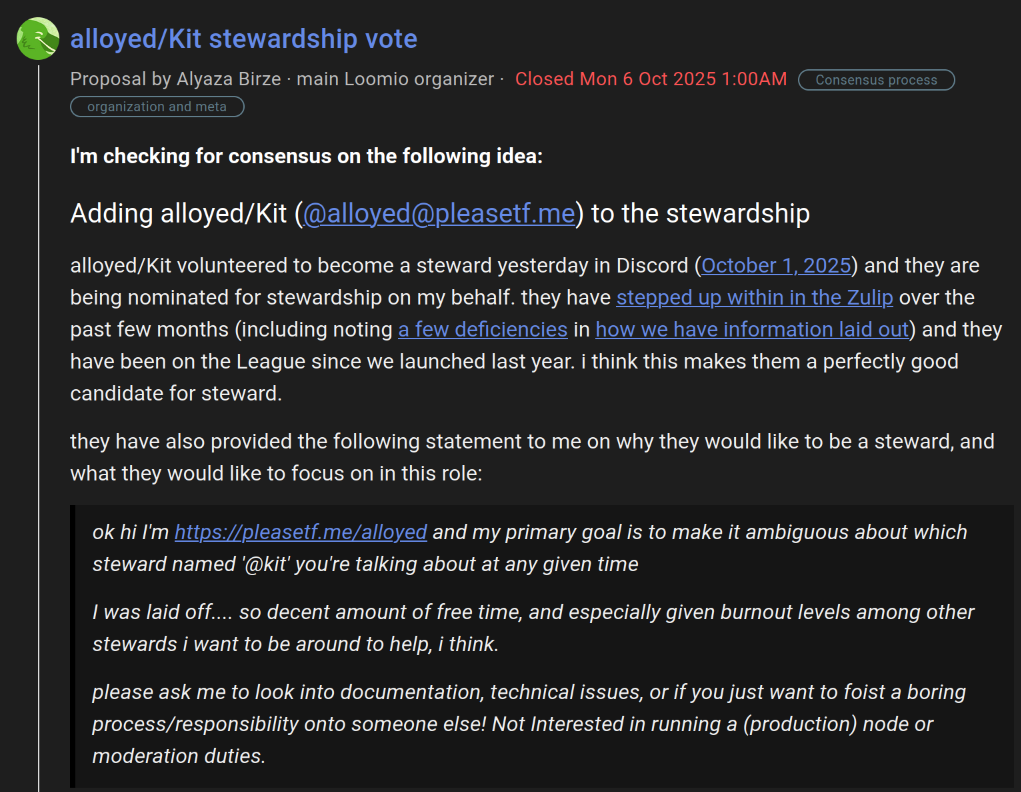
And then the vote will go through. Consensus means that of all the people that vote, nobody should have an objection to you joining. Good luck!
Central Services
The following services are used in the day-to-day work of being a steward:
| Name | Software | Purpose |
| Consensus | Loomio | The core voting platform. |
| Coordination | Zulip | Real-time chat, like Slack. |
| Information | Bookstack | Shared Wiki and reference material, like Confluence (you're here right now!) |
| Planning | Vikunja | Project and Task tracking, like Jira. |
| Authentication | KeyCloak | Single Sign On (SSO) provider, like Active Directory |
Anybody can sign up for these services and view the work behind stewardship, even without being a steward themself.
As a new/prospective steward, you should first sign up for Authentication. Then you can log into these other services, including Zulip/Coordination, and introduce yourself! Should you want to do work within each of these systems steward, you should ask for permissions for each service you plan to use: they each have their own access control systems internally (yep).
How to set up votes on Loomio (Consensus)
- Go to Loomio.
- Click 'Decisions'

- Click 'New Decision'

- Choose from the available templates depending on the situation.
Each of them have more details about when to use them inside of the template itself.

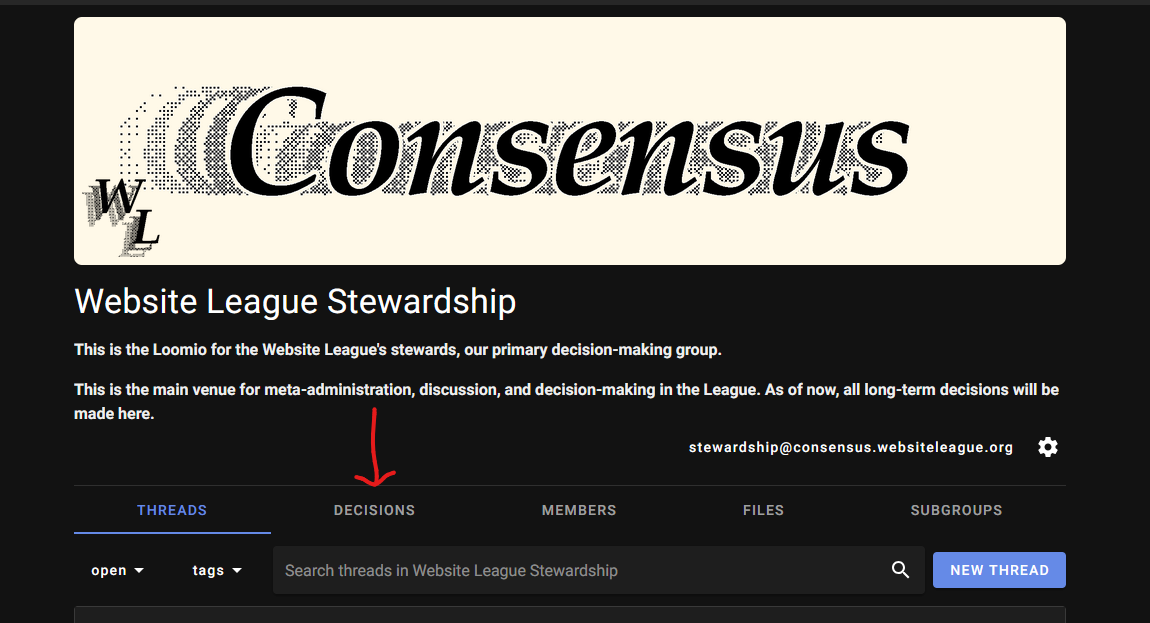
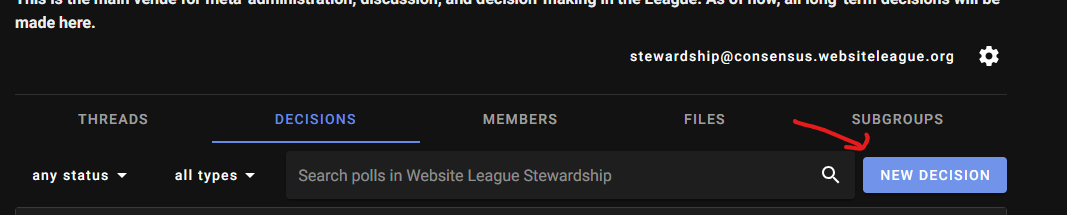
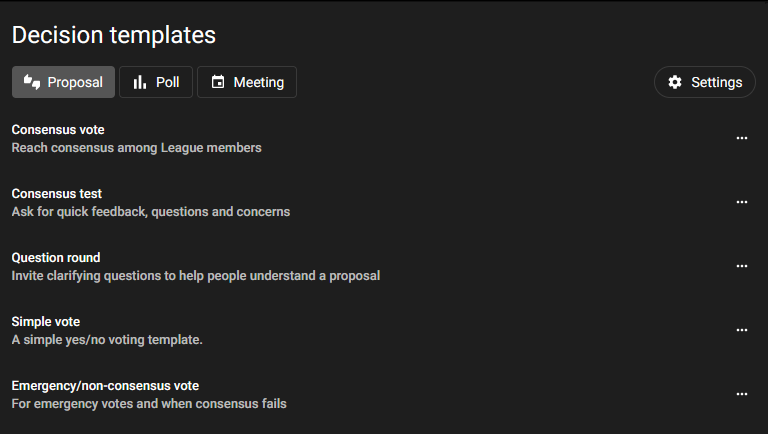
The template descriptions as of 2024/11/09 are captured below. Loomio is the definitive source for them and this page may be out of date.
Consensus Vote
Build consensus for a decision we need to make, and reach an agreement that satisfies the needs and concerns of all League members.
-
Discuss and develop a proposal together
-
Include and respect everyone involved
-
Seek a consensus on the subject
Additional reading:
Consensus Test
This is a way to test for quick consensus on something. In short, if you feel that something falls along these lines, this template is a good way to check it in a way everyone can see:
If a decision is minor enough that the length of discussion will probably not take longer than going through a vote, than just consense informally by making a suggestion, looking for approval, asking if there are any objections, and moving along. If an issue is complex or controversial enough that the discussion will definitely take longer than the process of making a proposal and voting on it, it makes sense to use a formal, explicit consensus process.
By default, these are set to be open for one day; please do not take that as a hard and fast rule, though. Please do not treat these as formal, binding votes either. If someone makes a proposal that conflicts with a consensus vote, take the proposal over the quick consensus vote.
Question round
A question round is an opportunity for people to ask clarifying questions about an idea or proposal; this way, potential issues can be resolved in advance and people can better understand the proposal and what it is intended to solve.
Question rounds have no voting options. By default, these are set to last one week.
Simple Vote
This is a simple yes/no vote proposal template—it's pretty self explanatory. If for some reason you need a proposal template like this, please use this and not the emergency/non-consensus proposal template.
Emergency/non-consensus vote
Because we operate on a consensus system, as of right now this is a template that should only be used in one of two cases, which are:
-
A situation in which consensus has completely broken down but a decision must be made for one reason or another. In this case a two-thirds majority is required;
-
An emergency addition to the decision making group. In this case, a two-thirds majority is required and any person(s) added by vote must also eventually go through the usual consensus process to remain in the group.
In short, this template should not appear in usual circumstances. If you need a simple-vote template for some reason, please do not use this. There should be another one labeled "simple vote" for those purposes.
Default duration for a poll of this variety is one day. Please adjust this if that is needed.
Vote Categories
Note: these categories are currently provisional.
source: Website League notes
- Endorse: Unreserved support
-
No objection: “I’ll go along with it.”
-
Minor objection: “I have some reservations but am willing to let the proposal pass.”
-
Stand aside: “I personally can’t do this, but I won’t stop others from doing it.” The person standing aside is not responsible for the consequences - this should be recorded in the minutes.
-
Major objection: “I have serious issues with this proposal that must be addressed to receive my support.” A single major objection acts as a veto, and blocks the proposal from passing
-
Abstain: None of the above/the recusal option
How to talk on Zulip (Coordination)
- New Zulip user tips:
- Research and analysis references (a Zulip topic linking out to more resources)
How to write documentation in Bookstack (Information)
Bookstack is the software you are reading this on right now! Some guidelines for writing documentation:
Make large books
Bookstack organizes things into "books", "chapters", and "pages". Books are meant to be read or skimmed linearly, like a real book with a real table of contents. this means you should use the "sort" function liberally, to keep books in a rough information hierarchy, and putting two pages in the same book/chapter is a good way to make sure that a reader sees both.
Page titles are searchable, Page contents are not
the search bar at the top of the page can pull up any page based on what's specifically in the title of that page. this means that an ideal title will include key words that make it easy to search for. Information buried in a sub-heading will probably be harder to search for, which may or may not be a good thing.
Stay current
If something is out of date, update it! Avoid referencing changes that will happen, or are planned to happen.
Consider the purpose of your doc
Where possible, try to figure out if your doc is meant to be:
- A reference, recording abstract information for later
- A how-to guide, describing how to do a concrete thing
- An explanation, describing why and how things got to be the way they are
- Or a tutorial, which is a guided how-to guide that is meant to teach the reader.
This is known as the Diátaxis system.